SAP licensing can be difficult to understand, particularly when an organization has thousands of users with very different levels of system usage. Full Use Equivalent (FUE) provides a standardized way to measure this usage by converting different user categories into a common licensing unit.
Understanding FUE is important for SAP customers because user classification, actual system usage, and contractual licensing terms can directly influence licensing costs.
1. What is FUE?
FUE stands for Full Use Equivalent.
It is a licensing measurement used by SAP to express different types of users in terms of a common unit. Instead of treating every user as requiring the same level of license, SAP assigns different user categories different FUE conversion factors.
For example, depending on the applicable SAP contract, a user category may represent:
- 1.0 FUE – a user requiring extensive functionality
- 0.2 FUE – a user with more limited usage
- 0.1 FUE – a user primarily performing self-service activities
The exact categories and conversion ratios depend on the SAP agreement and product/licensing model.
2. Why did SAP introduce FUE?
Traditional SAP licensing often involved different named-user license types, each associated with particular levels of functionality.
The FUE approach provides a more standardized way of looking at the overall user population. Rather than simply counting employees, organizations can calculate their licensing requirement based on the combination of user categories and their respective conversion factors.
This is particularly relevant in modern SAP S/4HANA and cloud-oriented licensing models.
3. How is FUE calculated?
The basic principle is straightforward:
Total FUE = Number of users in each category × Applicable FUE ratio, summed across all categories
For example, consider an organization with the following hypothetical user population:
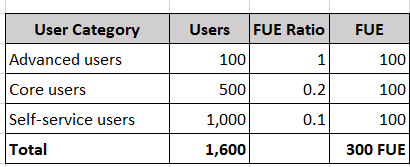
In this example:
100 + 100 + 100 = 300 FUE
The organization therefore has a licensing requirement equivalent to 300 FUE, assuming these categories and ratios are those defined in its contract.
Important
These numbers are illustrative only. SAP FUE ratios are not universal across every SAP agreement. Always use the definitions and conversion factors applicable to your specific contract.
4. FUE is not simply a headcount metric
One of the most important concepts to understand is that:
1,000 users do not necessarily equal 1,000 FUE.
An organization might have thousands of employees accessing SAP, but many of them may perform only occasional or limited activities.
For example:
- A finance manager may perform complex financial transactions.
- A warehouse employee may perform a limited number of operational transactions.
- An employee may only submit leave or expense requests.
- A supplier or external party may have highly restricted access.
These different usage patterns can result in significantly different licensing requirements.
Therefore, user population and FUE consumption are two different measurements.
5. User classification is critical
FUE calculations are only as accurate as the underlying user classification.
A common licensing risk occurs when users are classified based on their job title rather than their actual SAP usage.
For example, an employee may have the title “Manager” but use SAP only for basic approvals. Conversely, an employee with a relatively junior title could perform transactions that require a more extensive level of SAP functionality.
Therefore, organizations should evaluate:
- What transactions does the user perform?
- Which applications do they access?
- What functionality do they consume?
- How frequently do they use SAP?
- Does their actual usage correspond to their assigned user category?
Actual usage should be considered when validating classification, subject to the definitions in the applicable SAP agreement.
6. Why FUE matters for SAP license management
FUE management is not just a procurement exercise. It should be part of an organization’s ongoing SAP Software Asset Management (SAM) and license governance process.
Poor user classification can result in:
- Unexpected licensing costs
- Compliance exposure
- Over-licensing
- Under-licensing
- Difficult contract negotiations
- Unnecessary license purchases
For this reason, organizations should periodically compare their licensed users against actual usage data.
7. How to monitor FUE
SAP customers can use available SAP license-management capabilities, including tools such as SAP License Administration Workbench (LAW) and relevant user classification functionality, depending on their SAP landscape and licensing agreement.
A typical review process can include:
- Extract the current SAP user population
- Identify user categories
- Analyze actual system usage
- Review assigned classifications
- Calculate the resulting FUE consumption
- Identify inactive or unnecessary users
- Investigate users whose classification may not match their usage
- Document the results for audit and contract management
This process should be repeated periodically rather than performed only immediately before an SAP audit.
8. FUE and SAP cloud/Rise agreements
FUE can also be relevant in SAP cloud and RISE with SAP commercial models, but organizations should avoid assuming that every RISE or cloud contract uses exactly the same FUE structure.
The commercial model, products included, metric definitions, entitlements, and conversion rules are determined by the specific SAP agreement.
Therefore, when evaluating a RISE or cloud proposal, organizations should review:
- The contracted FUE quantity
- Included user categories
- Conversion ratios
- Product scope
- Entitlements
- Growth assumptions
- Measurement methodology
- Contractual true-up or adjustment provisions
9. Plan for future growth
One of the biggest mistakes organizations can make is calculating FUE requirements based only on today’s users.
A proper licensing assessment should consider expected changes such as:
- Business growth
- New employees
- Acquisitions and divestitures
- New SAP modules
- New business processes
- Increased automation
- Expansion into new countries
- Changes in employee roles
- Increased adoption of SAP applications
For example, an organization that currently requires 500 FUE may require considerably more after expanding its business operations.
FUE planning should therefore be part of the SAP roadmap and commercial strategy, not an afterthought.
FUE Governance: A Recommended Approach
A mature SAP license-management process can be structured around five activities:
1. Discover
Maintain an accurate inventory of SAP users, systems, applications, and access.
2. Classify
Map users to the appropriate contractual user categories.
3. Measure
Use available SAP tools and usage information to validate actual consumption.
4. Optimize
Remove unnecessary access, identify inactive users, and correct inappropriate classifications.
5. Forecast
Model future FUE requirements before making major SAP licensing or transformation decisions.
Key Takeaways
FUE is more than a simple user-counting mechanism. It provides a common licensing measurement that can translate different categories of SAP users into an equivalent licensing requirement.
The most important points are:
- FUE = Full Use Equivalent.
- Different user categories can have different FUE conversion factors.
- Total FUE is calculated by applying the applicable ratio to each user category and adding the results.
- FUE is not the same as employee or SAP user headcount.
- User classification should reflect actual usage and the definitions in the applicable contract.
- Regular license and usage reviews can help identify over-licensing and compliance risks.
- FUE requirements should be considered when planning SAP S/4HANA, cloud, and RISE commercial strategies.
- FUE ratios and definitions are contract-specific, so organizations should not rely on generic ratios without checking their SAP agreement.
Final Thought
The real value of FUE management is not simply knowing how many FUEs an organization consumes today. It is understanding why those FUEs are being consumed, whether the classifications are accurate, and how the requirement is likely to change as the SAP environment evolves.
A disciplined FUE governance process can therefore become an important part of SAP License Management, Software Asset Management, audit readiness, and SAP commercial planning.
Follow me to catch the full series as it drops. Each article builds on the last.
#SAPAI #SAP #ArtificialIntelligence #MachineLearning #GenerativeAI #SAPConsultant #BusinessAI #Joule #SAPJoule #EnterpriseAI #S4HANA #SAPS4HANA #SuccessFactors #DigitalTransformation #SAPBTP #CAPM #SAPDeveloper #GenerativeAIHub #SAPAICore #MultiModel #GPT4 #Claude #Gemini #SAPBTPAI #ModelSelection #AIForBeginners #NoVendorLockIn #SAPCloud #CloudApplicationProgrammingModel #SAPTraining #SAPCareer #ABAP #SAPHANA #CloudComputing #EnterpriseApplications #TechSkills #CareerGrowth #Upskilling #JouleAgents #AgenticAI #SAPBuild #SAPIntegrationSuite #AutonomousEnterprise #FutureOfWork #BusinessTechnologyPlatform #SAPCommunity #Innovation #SAPSD #AIAgents #ERP #LearningInPublic #S4HANAPublicCloud #SAPPublicCloud #SAPLicensing #SAPCloudERP #CloudERP #BusinessTransformation #ITStrategy #EnterpriseArchitecture #SAPConsulting #SubscriptionModel #CloudMigration #TechnologyLeadership #CIO #EnterpriseTechnology #DigitalEnterprise #SAPLearning #SAPExperts #ERPTransformation #FutureOfERP #SAPCloudALM #ALMSummit2026 #SolutionManager #ApplicationLifecycleManagement #SAPAI #Joule #EnterpriseAI #S4HANA #AIAgents #SAPSecurity #BusinessAI #DigitalTransformation #SAPConsulting #Anthropic #SAP #SAPHANA #SAPHANACloud #SAPBTP #SAPBasis #CloudComputing #DatabaseAdministration #SAPTechnology #CloudArchitecture #DigitalTransformation #SAPSecurity #SAPGRC #AccessGovernance #SoD #SAP #S4HANA #Fiori #BusinessRoleManagement #IdentityAccessManagement #CyberSecurity #SAPSecurityGovernance #SAP #SAPBasis #SAPJoule #SAPAI #BusinessAI #SAPHANA #SAPBTP #SAPAutomation #SAPSecurity #SAPConsulting #AIOps #DigitalTransformation