For years, SAP organizations have depended heavily on a small number of experienced consultants and key users.
Someone knows how to create a role.
Someone knows how to troubleshoot a failed transport.
Someone knows the exact steps for month-end activities.
Someone knows which configuration documents to check before making a change.
And often, that knowledge lives in a consultant’s experience—not in the SAP system.
This creates a familiar problem:
What happens when the person who knows the process is unavailable?
This is where I think Claude Cowork introduces an interesting possibility for SAP organizations.
Anthropic has positioned Cowork as an agentic workspace: instead of simply answering questions, Claude can take a multi-step task, plan the work, use files and connected tools, interact with applications, and produce the required outcome.
Now imagine applying that concept to SAP.
Consider a simple example
An SAP security consultant has performed the following task hundreds of times:
“Create a new business role based on an existing role.”
Today, the process might look like:
→ Consultant receives the request → Reviews the business requirement → Identifies the reference role → Checks naming conventions → Reviews authorization objects → Creates/copies the role → Adjusts organizational values → Generates the profile → Performs validation → Documents the change → Sends it for approval
The consultant knows the process because they have performed it repeatedly.
Now imagine capturing that process as an AI Skill / reusable workflow.
Instead of asking:
“How do I create this SAP role?”
a customer could potentially assign:
“Perform the standard role-creation procedure for this request.”
The AI agent could then:
- Read the business request.
- Identify the applicable standard procedure.
- Review the required documentation.
- Check the reference role and required inputs.
- Execute the permitted steps through the appropriate SAP integration.
- Validate the result.
- Produce the documentation.
- Ask for human approval where required.
The important shift is subtle but powerful:
We move from AI answering questions to AI executing institutional knowledge.
The SAP consultant’s experience becomes an asset
This could change how we think about SAP knowledge management.
Today:
Consultant → performs task → knowledge stays largely with consultant
A more mature AI-enabled model could become:
Consultant → performs task → process is documented → AI Skill/workflow is created → AI agent can repeat the process
Anthropic’s Skills capability is particularly relevant here because Skills can provide specialized knowledge and workflows to Claude, including organization-provisioned skills for enterprise users.
That means an organization could potentially build a library of reusable SAP workflows such as:
- SAP role creation
- Role modification
- User provisioning checks
- Transport validation
- Master-data checks
- Month-end preparation
- Configuration comparison
- Incident analysis
- Audit evidence preparation
- SAP testing documentation
- Change-impact analysis
- Functional specification preparation
The objective isn’t to make every SAP task autonomous.
The objective is to make repeatable SAP knowledge executable.
Where Cowork could fit
A simplified architecture could look like this:
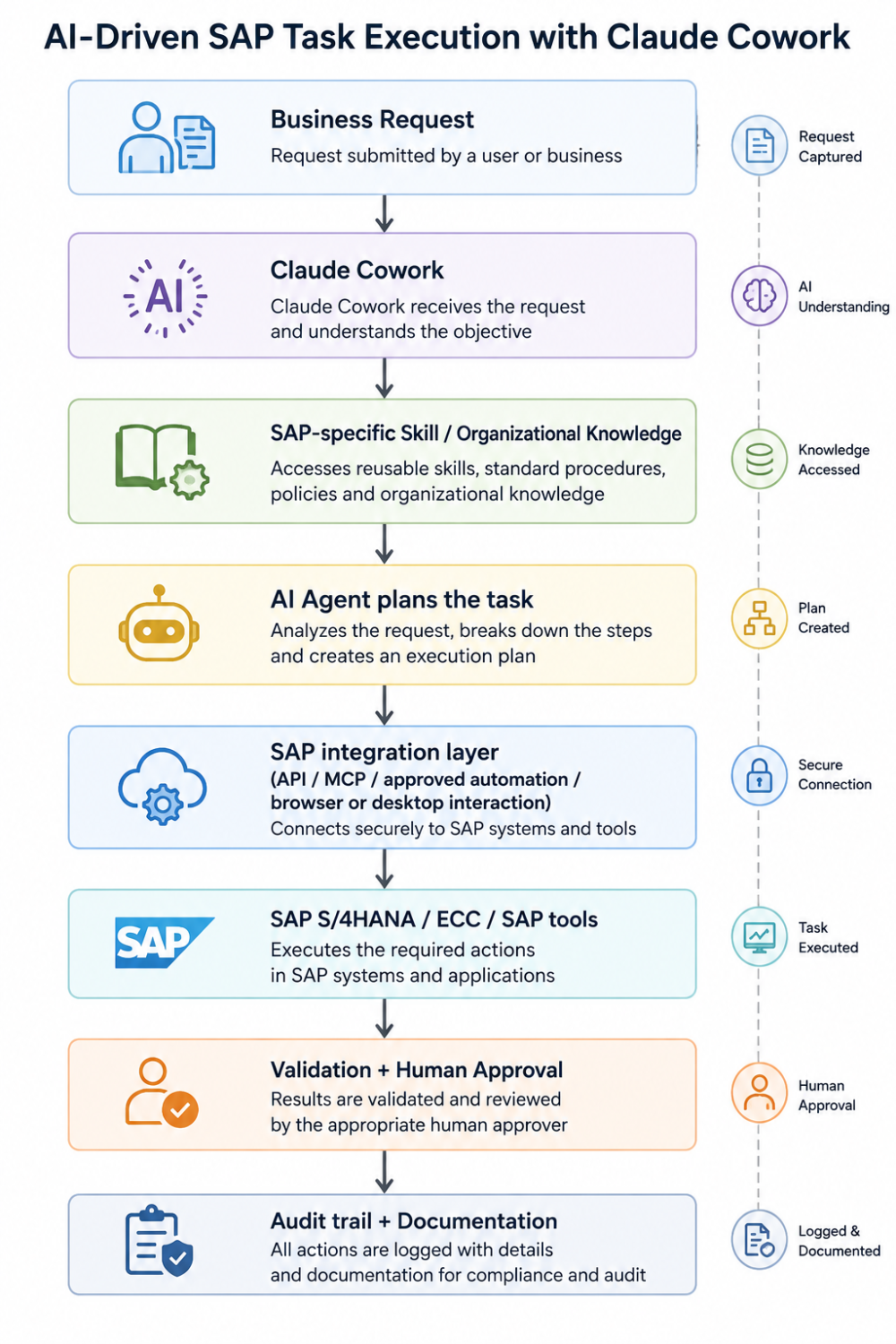
This last part is critical.
In SAP, “the AI completed the task” is not enough.
We need:
Who requested it? What did the agent do? Why did it do it? What data did it use? What changed? Who approved it? What was the final result?
For regulated SAP environments, governance must remain part of the architecture.
The biggest opportunity may not be automation
I think the bigger opportunity is organizational memory.
Many SAP organizations have decades of implementation knowledge distributed across:
- consultants
- functional specifications
- configuration documents
- SharePoint folders
- Excel files
- Jira/ServiceNow tickets
- transport documentation
- solution designs
- previous incidents
- emails
- project lessons learned
An AI agent could potentially bring this knowledge together and turn it into repeatable operational workflows.
Imagine a new consultant joining an SAP project.
Instead of spending months learning:
“How does this organization normally perform this task?”
they could potentially ask the organization’s AI agent to execute the established process—or guide them through it—with the organization’s own standards and historical knowledge.
That is a very different concept from simply using ChatGPT or Claude as a question-and-answer tool.
But there is an important warning
We should not confuse knowledge of a process with permission to execute the process.
An AI agent may know exactly how to create an SAP role.
That does not mean it should automatically create one in production.
The future SAP AI architecture therefore needs strong controls around:
Identity → Authorization → Segregation of Duties → Approval → Execution → Validation → Audit
AI can potentially automate the workflow.
Governance decides where the AI is allowed to act.
My view
The next evolution of SAP automation may not be:
RPA + AI
or simply:
Copilot + SAP
It could become:
Organizational Knowledge + AI Skills + Agents + SAP APIs + Human Governance
And that creates an interesting possibility:
A consultant doesn’t just complete a task.
They teach the organization how the task should be done.
Once that knowledge is structured correctly, an AI agent may be able to perform the repeatable parts of that work again and again.
The real transformation is therefore not:
“AI replaces the SAP consultant.”
It is:
“The SAP consultant’s expertise becomes reusable, scalable and executable.”
That is where I believe the conversation around AI and SAP becomes much more interesting.
Follow me to catch the full series as it drops. Each article builds on the last.
#SAPAI #SAP #ArtificialIntelligence #MachineLearning #GenerativeAI #SAPConsultant #BusinessAI #Joule #SAPJoule #EnterpriseAI #S4HANA #SAPS4HANA #SuccessFactors #DigitalTransformation #SAPBTP #CAPM #SAPDeveloper #GenerativeAIHub #SAPAICore #MultiModel #GPT4 #Claude #Gemini #SAPBTPAI #ModelSelection #AIForBeginners #NoVendorLockIn #SAPCloud #CloudApplicationProgrammingModel #SAPTraining #SAPCareer #ABAP #SAPHANA #CloudComputing #EnterpriseApplications #TechSkills #CareerGrowth #Upskilling #JouleAgents #AgenticAI #SAPBuild #SAPIntegrationSuite #AutonomousEnterprise #FutureOfWork #BusinessTechnologyPlatform #SAPCommunity #Innovation #SAPSD #AIAgents #ERP #LearningInPublic #S4HANAPublicCloud #SAPPublicCloud #SAPLicensing #SAPCloudERP #CloudERP #BusinessTransformation #ITStrategy #EnterpriseArchitecture #SAPConsulting #SubscriptionModel #CloudMigration #TechnologyLeadership #CIO #EnterpriseTechnology #DigitalEnterprise #SAPLearning #SAPExperts #ERPTransformation #FutureOfERP #SAPCloudALM #ALMSummit2026 #SolutionManager #ApplicationLifecycleManagement #SAPAI #Joule #EnterpriseAI #S4HANA #AIAgents #SAPSecurity #BusinessAI #DigitalTransformation #SAPConsulting #Anthropic #SAP #SAPHANA #SAPHANACloud #SAPBTP #SAPBasis #CloudComputing #DatabaseAdministration #SAPTechnology #CloudArchitecture #DigitalTransformation #SAP #SAPBASIS #S4HANA #SAPCloud #CloudComputing #AWS #Azure #SAPHANA #DevOps #Automation #CloudMigration #SAPCommunity #SAP #SAPConsulting #Claude #ClaudeCowork #AI #GenerativeAI #AIAgents #SAPAutomation #SAPSecurity #S4HANA #DigitalTransformation #EnterpriseAI