Most people think AI Engineering is a ladder.
First you learn prompting. Then you build agents. Finally, you build multi-agent graphs.
That mental model is wrong.
These are not experience levels—they are architectural building blocks. Every production AI system uses all of them simultaneously.
A modern enterprise AI application isn’t “an agent.” It is an engineered system composed of prompts, retrieval, tools, workflows, observability, evaluation, and governance.
The real roadmap is understanding which architectural pattern solves which problem, and adding complexity only when the layer below reaches its limits.
Layer 1 — Foundation Models
Everything starts with the model.
Before writing a single prompt, understand what you’re working with.
A Large Language Model predicts the next token based on context. It has no memory of previous conversations, no knowledge of your organization, and no ability to interact with external systems unless you explicitly provide those capabilities.
The model provides:
• Language understanding • Reasoning • Code generation • Summarization • Planning • Natural language interaction
The model does not provide:
• Enterprise knowledge • Live business data • Tool execution • Long-term memory • Workflow orchestration
Those capabilities must be engineered around it.
Layer 2 — Prompt Engineering
Every AI system eventually reaches this layer.
A prompt is not merely an instruction.
It is the context that conditions the model toward a desired output.
The five prompt primitives remain fundamental:
• Role or Persona • Context and Grounding • Task Specification • Constraints • Examples (Few-shot)
Good prompts reduce ambiguity.
Great prompts reduce failure modes.
Prompt engineering is still one of the highest ROI skills because every workflow, every agent, and every graph ultimately invokes the model through prompts.
But prompts alone have limits.
They cannot access live systems.
They cannot retrieve enterprise knowledge.
They cannot perform actions.
Layer 3 — Knowledge (RAG)
One of the biggest misconceptions in AI is trying to solve missing knowledge with longer prompts.
That rarely works.
Instead, modern AI systems retrieve relevant information at runtime.
Retrieval-Augmented Generation (RAG) introduces:
• Vector search • Hybrid search • Enterprise documentation • SAP documentation • Policies • Knowledge bases • SharePoint • Confluence • Databases
Rather than forcing a model to memorize information, we provide the right context at the right time.
Knowledge retrieval often improves quality far more than prompt optimization.
Layer 4 — Tool Use
Reasoning is useful.
Action creates value.
Once models can call external tools, they stop being passive assistants and become active participants in business workflows.
Examples include:
• SAP BAPIs • RFC calls • REST APIs • SQL databases • Email • Microsoft Teams • Slack • ServiceNow • GitHub • File systems
The model decides what needs to happen.
The tools perform how it happens.
This separation is critical for reliability.
Layer 5 — Agent Loops
An agent is not magic.
It is an LLM operating inside a control loop with access to tools and state.
The cycle looks like this:
Observe → Reason → Act → Observe → Repeat
Popular implementations include:
• React • Plan-and-Execute • Reflexion • Tool Calling • Iterative Planning
Agents excel when tasks require:
• Multiple reasoning steps • Dynamic decision making • Tool selection • Error recovery • Information gathering
However, every production agent requires guardrails:
• Maximum step budget • Explicit stop conditions • Retry policies • Human approval before irreversible actions • Structured logging
Without these controls, agents become unpredictable.
Layer 6 — Workflow Orchestration
Many problems don’t require autonomous agents.
They require deterministic workflows.
Examples:
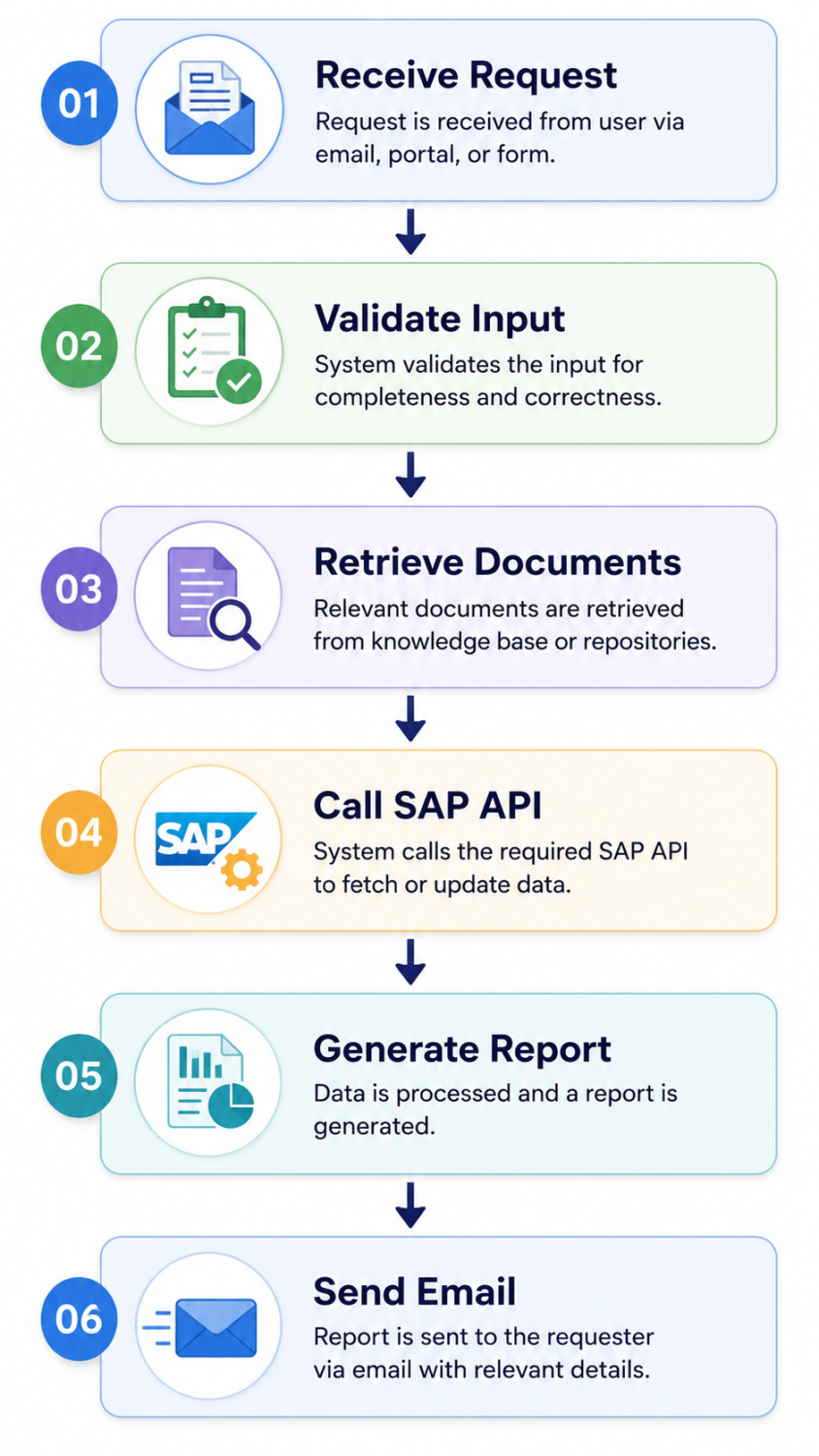
Most enterprise systems benefit from explicit workflows because they are easier to debug, audit, and secure.
Frameworks such as LangGraph, Temporal, Prefect, and enterprise workflow engines excel here.
Layer 7 — Multi-Agent Systems
A graph is not a smarter agent.
It is a coordination framework for multiple specialized workers.
Each node performs one responsibility.
Examples:
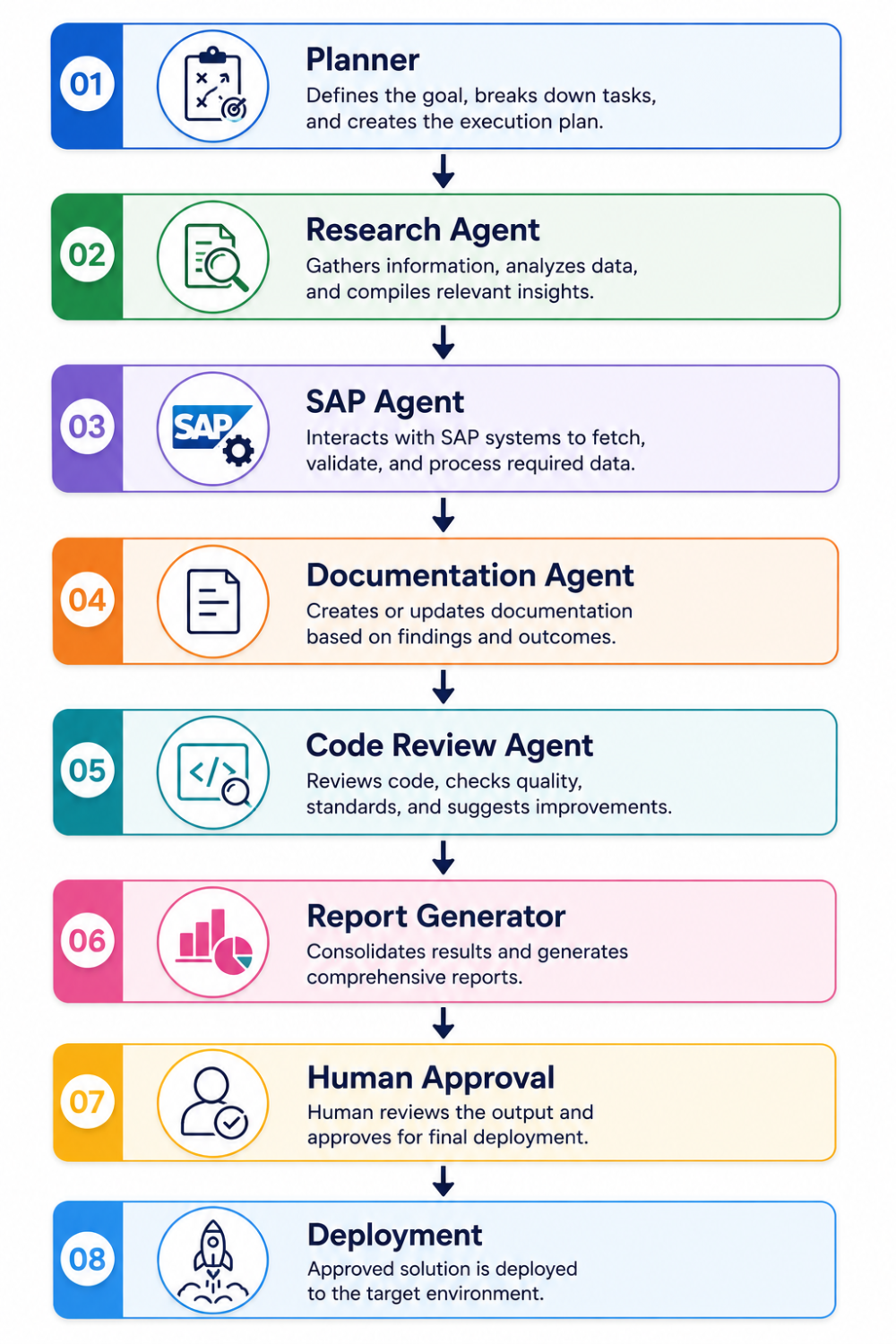
Different graph topologies solve different problems:
Pipeline
Sequential processing
Fan-out/Fan-in
Parallel research
Hierarchical
Manager coordinating specialists
Peer Review
Debate and critique
Iterative
Draft → Review → Improve
The intelligence lives inside the nodes.
The graph provides coordination.
Layer 8 — MCP (Model Context Protocol)
As enterprise AI grows, tool integration becomes the bottleneck.
MCP standardizes how AI models discover and use external capabilities.
Instead of writing custom integrations for every application, MCP exposes tools through a common interface.
Examples:
SAP
GitHub
Jira
Slack
Databases
Files
Cloud Services
MCP enables models to interact with enterprise ecosystems without bespoke connectors for every project.
It is becoming an important interoperability layer rather than another agent framework.
Layer 9 — Production Engineering
This is where most AI projects fail.
Not because of poor models.
Because of poor engineering.
Production AI requires:
Evaluation
- Regression datasets
- Benchmark tasks
- Hallucination testing
- Accuracy measurement
Observability
- Prompt logs
- Tool traces
- Agent traces
- Distributed tracing
- Error analysis
Cost Management
- Token usage
- API costs
- Cache hit rates
- Budget controls
Security
- RBAC
- Secrets management
- Prompt injection defense
- Tool authorization
Governance
- Human approval
- Audit logs
- Compliance
- Policy enforcement
Enterprise AI is ultimately a software engineering discipline.
Layer 10 — Business Systems
The highest layer is not AI.
It is business value.
The objective isn’t building impressive agents.
The objective is improving business outcomes.
Examples:
SAP role provisioning
GRC risk analysis
Transport management
Audit automation
Finance approvals
Procurement workflows
Incident management
Customer support
The AI layer should enhance existing enterprise processes—not replace deterministic business logic where reliability and auditability matter.
Choosing the Right Architecture
Ask these questions before adding complexity.
Can a single prompt solve it?
Use Prompt Engineering.
↓
Does it need external knowledge?
Add Retrieval (RAG).
↓
Does it need live systems?
Add Tool Calling.
↓
Does it require iterative reasoning?
Use an Agent Loop.
↓
Does it involve multiple specialized tasks or parallel work?
Use a Multi-Agent Graph.
↓
Is it entering production?
Invest in observability, evaluation, governance, and security before scaling.
The Uncomfortable Truth
Most AI failures are not model failures.
They are architecture failures.
Teams often add more prompts when they need retrieval.
They add more agents when they need workflows.
They add more models when they need observability.
The best AI system is rarely the most complex.
It is the simplest architecture that consistently meets the reliability, security, cost, and business requirements.
That is what separates AI demos from production AI engineering.
AI Engineering isn’t about building smarter prompts or more agents.
It’s about designing reliable systems where models, knowledge, tools, workflows, and governance work together to solve real business problems.