SAP S/4HANA transformation is often presented as a technology journey.
But the numbers tell us something different.
The biggest challenge is not simply moving from SAP ECC to S/4HANA.
The real challenge is delivering the transformation on time, within acceptable cost and risk, while actually achieving the business outcomes expected from it.
So, What Is the Success Rate?
There is no single global “SAP S/4HANA success rate.”
However, several studies provide useful indicators.
A Kearney survey of 200 organizations found that 90% described their previous ERP implementations as successful or mostly successful. However, when asked about their confidence in achieving the expected outcomes from their S/4HANA transformation, only 55% were very confident, while 27% were somewhat confident and 3% were not confident.
That gap is important.
Organizations may successfully implement an ERP system while still being uncertain about whether the transformation will deliver the expected business value.
Another study reported an even more concerning operational picture. According to research cited by CIO, among 37 organizations that had completed their S/4HANA transition, only 8% completed it on schedule. The study also found that projects took an average of 30% longer than initially planned, while 65% of completed migrations reported severe or very severe quality deficiencies after migration.
And this isn’t unique to SAP.
McKinsey reports that approximately three-quarters of ERP transformation projects fail to stay on schedule or within budget, while two-thirds have a negative ROI.
More recent McKinsey analysis similarly suggests that nearly 70% of ERP transformation programs fall short of realizing their full potential.
EY’s 2025 research goes even further, citing a 67% failure rate for transformations overall and emphasizing that leadership, trust, team behavior, and organizational conditions are major factors in transformation success.
So, if someone asks:
“What percentage of SAP S/4HANA projects succeed?”
The honest answer is:
There isn’t one reliable percentage.
But the available evidence consistently shows that large ERP transformations have a significant risk of missing schedule, budget, quality or expected business outcomes.
And that is exactly why project leadership matters.
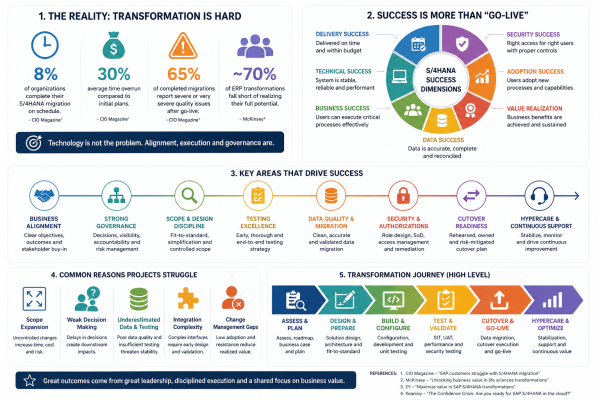
Why Do S/4HANA Transformations Struggle?
The technology is rarely the only problem.
The recurring challenges are much broader:
- Unclear business ownership
- Poor governance
- Scope expansion
- Weak decision-making
- Underestimated testing
- Inadequate data migration planning
- Integration complexity
- Security and authorization gaps
- Poor change management
- Insufficient business involvement
- Weak cutover preparation
- Lack of post-Go-Live stabilization
Interestingly, the S/4HANA migration research cited by CIO identified several of these exact issues, including scope expansion, weak project management, underestimated testing and data migration, decision-making problems and process redesign loops.
Success Should Not Mean “SAP Went Live”
This is where I think organizations need to change the way they define success.
A project can technically Go-Live and still be unsuccessful.
Imagine this scenario:
The system goes live on the planned date.
But:
- Critical interfaces fail.
- Users don’t have the required authorizations.
- Financial reconciliation takes days.
- Key reports don’t work correctly.
- Data quality problems appear.
- Business processes require manual workarounds.
- The support organization is overwhelmed.
Technically, the project went live.
Operationally, it failed to deliver the intended outcome.
That’s why I would define S/4HANA success across several dimensions:
1. Delivery Success
Was the transformation delivered within an acceptable timeline and budget?
2. Technical Success
Does the S/4HANA environment operate reliably?
3. Business Success
Can users execute critical business processes effectively?
4. Data Success
Is the migrated data accurate, complete and reconciled?
5. Security Success
Can users perform their jobs while maintaining appropriate access controls and segregation of duties?
6. Adoption Success
Are employees actually using the new processes and capabilities?
7. Value Realization
Did the organization achieve the business benefits that justified the transformation?
Only when these dimensions come together can we really call an S/4HANA transformation successful.
The Role of Governance
This is why governance is not administrative overhead.
It is a risk-control mechanism.
A strong S/4HANA program should continuously monitor:
Scope → Schedule → Budget → Risks → Issues → Dependencies → Testing → Data → Security → Cutover → Business Readiness
The objective isn’t to eliminate every problem.
That’s unrealistic.
The objective is to identify problems early enough that leadership can make informed decisions.
Testing Is a Leading Indicator
One of the biggest mistakes is treating testing as a final validation exercise.
Testing should progressively increase confidence.
Unit testing validates individual components.
Integration testing validates system interactions.
End-to-end testing validates business processes.
User acceptance testing validates business usability.
Regression testing validates existing capabilities.
Performance testing validates system behavior under load.
Security testing validates access.
And cutover rehearsals validate whether the organization can actually transition to production.
A project that reports “95% of test cases passed” isn’t necessarily healthy.
The better question is:
Are the remaining failures business-critical, and can they prevent Go-Live or business continuity?
Cutover Is Where Preparation Becomes Reality
A successful S/4HANA Go-Live isn’t created during the Go-Live weekend.
It is created through months of preparation.
- Mock conversions.
- Cutover rehearsals.
- Data validation.
- Transport sequencing.
- Interface validation.
- Business readiness.
- Security validation.
- Technical readiness.
- Rollback and contingency planning.
- Clear ownership.
Every critical cutover activity should have:
An owner. A deadline. A dependency. An entry criterion. An exit criterion. And an escalation path.
If any of these are missing, the risk is probably not fully understood.
The Human Factor
Technology doesn’t make decisions.
People do.
That is why the most successful S/4HANA programs typically have strong collaboration between:
- Business leadership
- SAP functional teams
- Technical teams
- Enterprise architecture
- Security/GRC
- Data teams
- Integration teams
- Infrastructure
- Testing teams
- Implementation partners
- Change-management teams
Everyone has a different responsibility.
But everyone must be aligned around one outcome:
A stable SAP platform that enables the business to operate better.
My Takeaway
The question shouldn’t be:
“What is the success rate of SAP S/4HANA projects?”
The better question is:
“What are we doing to make our S/4HANA transformation successful?”
The research suggests that large transformations carry substantial execution risk.
But that risk isn’t inevitable.
Strong governance, realistic planning, disciplined testing, effective change management, robust data and security controls, and experienced leadership can significantly improve the probability of success.
S/4HANA is not just an upgrade.
It is an organizational transformation.
And the organizations that recognize that difference are more likely to turn a technical migration into a successful business transformation.
References
- Kearney — Are you ready for SAP S/4HANA in the Cloud? The Confidence Crisis — survey of 200 organizations.
- CIO — SAP customers struggle with S/4HANA migration — reporting findings on schedule, budget and quality performance.
- McKinsey — Agile in enterprise resource planning: A myth no more — research on ERP transformation schedule, budget and ROI performance.
- McKinsey — Unlocking business value in life sciences transformations — analysis of ERP transformation value realization.
- EY — Maximize value in SAP S/4HANA transformations: The human factor — 2025 research on transformation failure and leadership factors.
- SAPinsider — The CIO’s 2024 Transformation Report Card — survey of 105 executives and decision-makers on transformation progress and outcomes.
- valantic — SAP Study 2026 — survey of 409 SAP customers/executives on the current state of S/4HANA transformation.
#SAP #S4HANA #SAPTransformation #ERP #SAPProjectManagement #SAPGRC #SAPSecurity #DigitalTransformation #ChangeManagement #SAPImplementation