For decades, SAP consulting has followed a familiar formula:
Understand the business → Configure SAP → Test → Transport → Support.
But what happens when AI can understand requirements, analyze processes, generate solutions, create test cases, identify risks, and execute parts of a business workflow?
We are moving toward a new model:
Human → AI Agent → SAP → Business Outcome
SAP itself is positioning Joule Agents and Assistants around multi-step workflow execution across Finance, Supply Chain, Spend, HCM and Customer Experience. (SAP)
And that raises a provocative question:
Will tomorrow’s SAP consultant still need to configure everything manually?
From Copilot to Agentic AI
Generative AI can explain an SAP error, write ABAP, summarize requirements or create documentation.
Agentic AI goes further.
An AI agent can potentially:
Understand → Plan → Execute → Evaluate → Adapt
Instead of asking:
“How do I configure this process?”
the consultant may increasingly ask:
“What is the best business outcome, and what should the AI agent do to achieve it safely?”
SAP describes Joule Agents as purpose-built agents that can plan and execute multi-step workflows across systems and domains, with assistants coordinating their work. (SAP)
That changes the role of the SAP consultant.
So, What Happens to SAP GRC?
This may be one of the most interesting areas.
Today:
User → Role → Authorization → Transaction
Tomorrow:
User → AI Agent → Identity → Permissions → APIs → Business Action
If an AI agent can perform business actions, we need to ask:
- What can the agent access?
- Which transactions can it execute?
- Does the agent create SoD conflicts?
- What approval limits should apply?
- Can it request or modify roles?
- How do we audit its decisions?
- When must a human approve the action?
The future SAP GRC consultant may therefore work less on simply identifying access conflicts and more on governing AI identities, permissions, actions and risk.
AI governance itself becomes part of enterprise GRC.
SAP is also emphasizing governed AI, including agent lifecycle management, security, accountability and control through its AI platform and Agent Hub. (SAP)
What Happens to SAP Finance?
Finance is one of the areas where Agentic AI could have enormous impact.
Imagine an AI agent supporting:
Record-to-Report
Accounts Receivable
Accounts Payable
Treasury
Financial Planning
Instead of simply reporting:
“There are 500 overdue invoices.”
an agent could analyze customers, payment history, disputes and risk, then recommend the next action.
The consultant’s role moves from configuring every individual step toward designing:
Business rules + controls + exceptions + approval boundaries
SAP is already positioning autonomous finance around areas such as close, planning, treasury and compliance. (SAP)
The finance consultant may increasingly become an AI-enabled finance process architect.
What Happens to Procurement and MM?
Imagine telling an AI agent:
“Find the best way to reduce procurement cost for this category without increasing supply risk.”
Instead of opening multiple reports and transactions, the agent could potentially analyze:
- Supplier performance
- Historical pricing
- Contracts
- Inventory
- Demand
- Lead times
- Purchase orders
- Market information
and recommend an action.
The traditional procurement consultant asks:
“How should we configure this purchasing process?”
The future consultant may increasingly ask:
“How should we design the decision framework that the AI uses?”
SAP’s current Autonomous Enterprise strategy explicitly includes spend management, sourcing, procurement, contracts and payments among the areas being transformed with AI. (SAP)
What Happens to SAP Supply Chain?
This is where Agentic AI becomes particularly powerful.
Supply chains are dynamic.
Demand changes.
Suppliers fail.
Inventory moves.
Transportation is delayed.
Production capacity changes.
A traditional system reports these events.
An intelligent system could potentially:
Detect → Analyze → Predict → Recommend → Execute
For example:
Demand suddenly increases for a product.
An AI agent could analyze inventory, production capacity, suppliers and logistics and recommend adjustments across planning and procurement.
Instead of one consultant configuring one process, multiple AI agents could coordinate across several processes.
SAP describes its autonomous supply-chain direction across planning, manufacturing, logistics and inventory. (SAP)
This means the future SCM consultant may focus increasingly on end-to-end orchestration rather than isolated module configuration.
What Happens to SAP HCM / SuccessFactors?
HR could be another major transformation.
Imagine:
“We need to identify skills gaps for our digital transformation.”
An AI system could analyze:
- Current workforce skills
- Job requirements
- Employee profiles
- Learning history
- Future workforce requirements
and recommend:
Who should be trained?
Which skills are missing?
Which roles are at risk?
What learning path should be created?
SAP’s autonomous HCM direction includes AI-supported hiring, skills development and workforce planning. (SAP)
The HCM consultant therefore moves toward designing human + AI workforce processes, not simply configuring HR screens.
What Happens to Sales & Customer Experience?
Imagine a sales organization asking:
“Which opportunities should receive immediate attention?”
An AI agent could analyze customer behavior, pipeline information, previous interactions and business context.
Instead of simply displaying a CRM dashboard, the system could potentially recommend:
Prioritize this opportunity.
Contact this customer.
Prepare this proposal.
Escalate this issue.
SAP’s autonomous CX strategy includes marketing, commerce, sales and service. (SAP)
The consultant’s job becomes less about configuring individual screens and more about designing intelligent customer journeys and decision processes.
What Happens to SAP ABAP?
This may be one of the biggest changes for technical consultants.
AI can already assist developers with:
- Code generation
- Code explanation
- Test creation
- Documentation
- Debugging
- Refactoring
But the bigger shift is architectural.
The question becomes less:
“Can AI write this ABAP?”
and more:
“Should we write this ABAP at all?”
That brings us directly to Clean Core.
If a standard SAP capability, API, workflow, BTP extension or AI agent can solve the requirement, custom code may no longer be the first answer.
AI could make development dramatically faster.
But that creates a new danger:
Technical debt at AI speed.
The consultant must therefore become the architect who decides what should be built, extended, integrated or automated.
What Happens to Basis and SAP Operations?
Today, operations teams spend significant time reacting to:
- Performance issues
- Failed jobs
- System alerts
- Interface failures
- Capacity problems
- Security events
Agentic AI could shift operations from:
Monitor → Alert → Investigate → Fix
toward:
Predict → Analyze → Recommend → Remediate
The important skill won’t disappear.
It changes.
Instead of manually investigating every alert, the SAP technical expert may increasingly govern AI-driven operations and handle the exceptions AI cannot safely resolve.
What Happens to Testing?
Testing could become another major transformation.
Imagine an AI agent analyzing a change and automatically identifying:
- Impacted business processes
- Relevant test cases
- Security implications
- Integration dependencies
- Regression scenarios
It could generate test scenarios and prioritize the highest-risk areas.
The consultant’s role moves from:
“Execute 500 test cases.”
toward:
“Design the testing strategy and validate AI-generated evidence.”
What Happens to Change & Transport Management?
Imagine AI reviewing a transport before production.
It could ask:
“What business processes are affected?”
“Which roles are impacted?”
“Has similar code caused problems before?”
“Which test cases should be executed?”
“What is the production risk?”
That moves Change Management from:
Tracking changes
toward:
Predicting change risk.
This could be particularly valuable in large SAP landscapes where one seemingly small change can have consequences across Finance, Procurement, Security and integrations.
The Biggest Change: Modules May Matter Less
This is perhaps the most important point.
Traditional SAP thinking is often organized around modules:
FI | CO | MM | SD | PP | HCM | GRC
But business processes don’t respect module boundaries.
A real business event might move through:
Sales → Inventory → Procurement → Production → Finance → Customer Service
Agentic AI is naturally suited to this cross-functional model because agents can coordinate across applications and workflows. SAP’s Autonomous Enterprise strategy explicitly describes AI agents working across business domains rather than only within isolated functions. (SAP)
So the future may be less about:
“I am an FI consultant.”
and more about:
“I understand the end-to-end Order-to-Cash process and know how AI can optimize it safely.”
That is a significant shift.
The New SAP Consultant
So, will SAP consultants disappear?
No.
But some consulting tasks will become increasingly automated.
The consultant who only knows:
“Which screen do I configure?”
may become less differentiated.
The consultant who understands:
Business + SAP + Architecture + AI + Security + Data + Governance
will become more valuable.
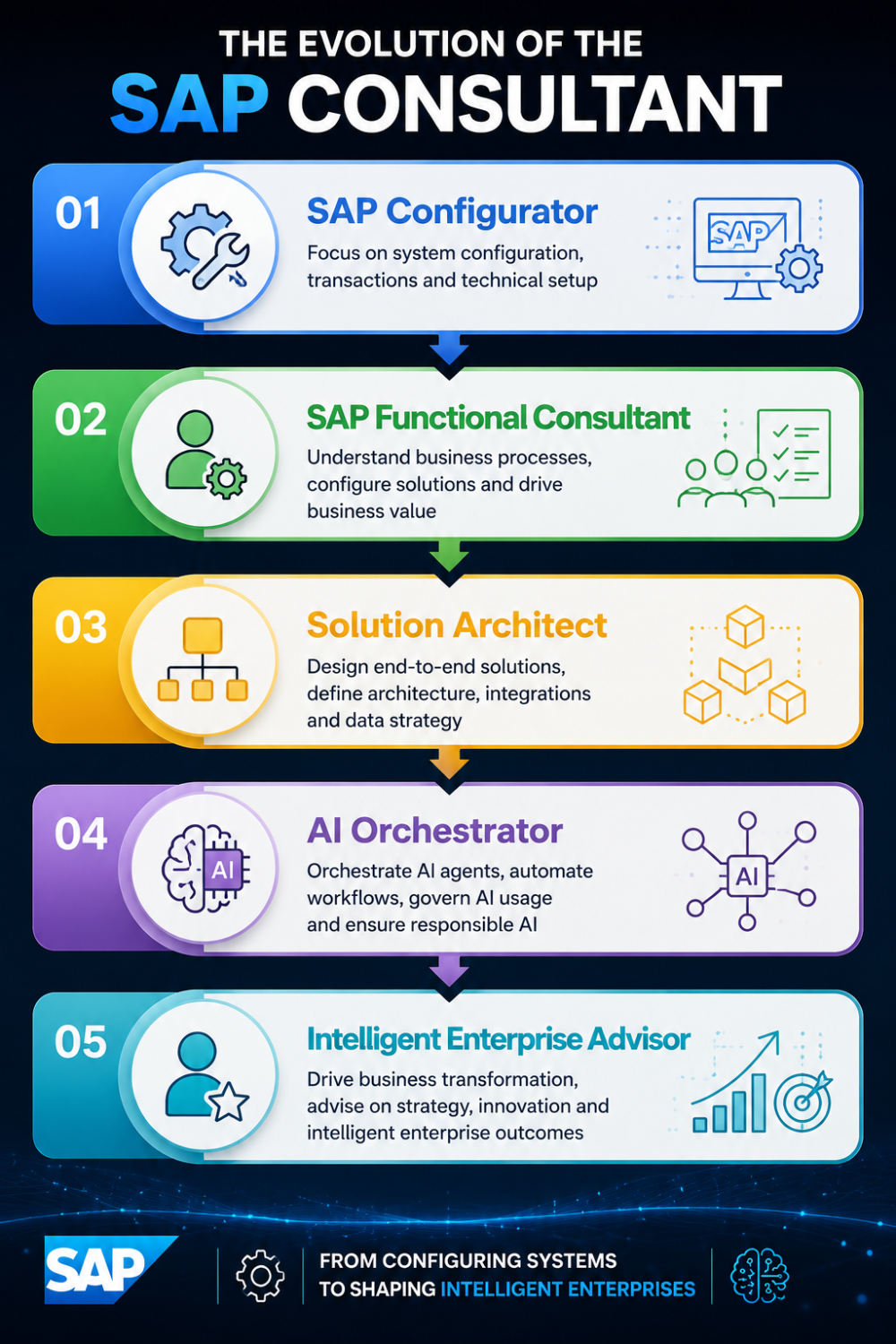
The role could evolve:
But Don’t Give AI Unlimited Power
There is one principle that should not be forgotten:
Automation without governance is simply automated risk.
Not every SAP action should be autonomous.
A useful model could be:
🟢 Low Risk → AI executes
🟡 Medium Risk → AI recommends, human approves
🔴 High Risk → AI analyzes, human decides and authorizes
Changing a report is one thing.
Changing a production authorization, financial master data or critical configuration is something entirely different.
The future should not be:
Human OR AI
It should be:
Human + AI + Governance
The Real Transformation
SAP’s direction is increasingly toward an enterprise model where people set intent, AI agents execute workflows, applications provide the business processes, and governance remains embedded throughout the lifecycle. (SAP)
That means the biggest change isn’t simply:
“AI will configure SAP faster.”
The bigger change is:
AI could change how SAP solutions are designed, operated, secured and governed.
And that affects almost every SAP discipline.
GRC.
Finance.
Procurement.
Supply Chain.
HCM.
Sales.
ABAP.
Basis.
Testing.
Architecture.
Change Management.
The Question for SAP Professionals
So, will tomorrow’s SAP consultant still need to configure everything?
Probably not.
But they will need to understand everything that matters.
When AI starts performing configuration, development and operational tasks, the consultant’s responsibility moves toward:
Designing the right solution.
Setting the right boundaries.
Managing the risks.
Validating AI decisions.
Protecting the business.
And ultimately:
Making sure AI doesn’t just execute faster—but executes the right thing.
That may be the real evolution of SAP consulting:
From Configuration → Orchestration → Governance → Intelligent Enterprise
The technology is changing.
The SAP modules are changing.
The consultant’s role is changing.
The real question is: Are we preparing for it?**
#SAP #AgenticAI #GenerativeAI #SAPConsulting #SAPGRC #SAPSecurity #S4HANA #SAPFinance #SAPMM #SAPSD #SAPHCM #SAPSupplyChain #SAPABAP #CleanCore #EnterpriseAI #ArtificialIntelligence #DigitalTransformation #SAPInnovation